
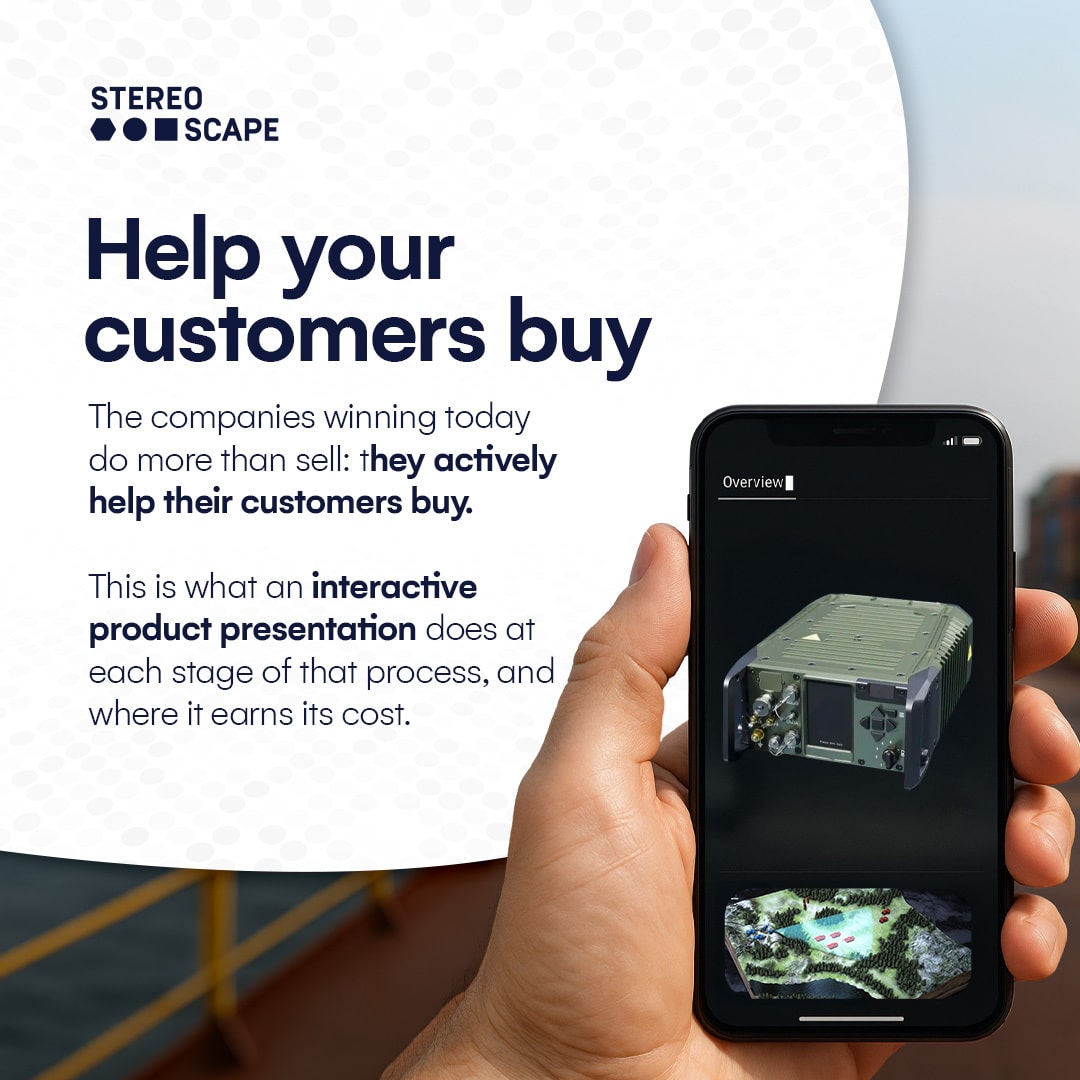

The buying process for complex industrial products has changed. Most product content hasn’t. The companies winning today do more than sell: they actively help their customers buy. This is what an interactive product presentation does at each stage of that process, and where it earns its cost.

A customer decides to buy a machine long before anyone from your company is in the room.
Research by 6sense across more than four thousand B2B buyers found that:
- Buyers approach suppliers around 61% of the way through their buying journey, up from 69% a year earlier
- 95% of the vendors who eventually win were already on the shortlist before that first contact
- The supplier the buying group preferred before any contact went on to win between 77 and 80% of the time
Gartner’s March 2026 survey of 646 buyers points the same way from a different angle: 67% of B2B buyers say they prefer to evaluate without a sales representative, and 45% used AI during their most recent purchase. Yet 69% still want a salesperson to validate what they have found. The salesperson has not become less important. Their moment has moved.
For a company selling complex industrial equipment, this is not an abstract shift. It means the most decisive weeks of the sale happen while your buyer is alone with your website, your PDF and their own imagination.
What buyers are actually doing before they contact you

Gartner describes modern B2B buying as a set of jobs rather than a funnel: identifying the problem, exploring solutions, building requirements, selecting a supplier, validating the choice and creating internal consensus. Buyers move backwards and forwards between them. A group comparing suppliers will return to redefining requirements. A group about to decide will go back and rebuild the business case because one person is not convinced.
A separate Gartner survey of 632 buyers puts a number on the difficulty. Buying groups now run from five to sixteen people across as many as four functions, and 74% of B2B buying teams show unhealthy conflict during the decision process. Groups that reach consensus are 2.5 times more likely to report a high-quality deal.
The hardest part of selling a complex product is not persuading the person in front of you. It is that person persuading everyone else, in meetings you will never attend, using whatever you gave them.
Six things buyers need help with
Taken together, research from Gartner, McKinsey, 6sense and TrustRadius points to the same six buyer needs.
- Understand. A simple visual explanation of something complicated.
- Explore. The ability to look at it themselves, at their own pace.
- Assess fit. Use cases, configurations and scenarios that resemble their own operation.
- Trust. References, proof and evidence that this has worked elsewhere.
- Justify. A business case: return, cost avoided, risk reduced.
- Build consensus. Something they can share across a group of ten people who each care about a different thing.
Many companies produce excellent material for the first three. Very few produce anything for the last two, and those are the two where deals are actually decided.
Where an interactive presentation sits in that process
An interactive product experience is a browser-based presentation of a machine, plant or system, built from existing CAD files and technical documentation. It combines 3D models with layered explanations, animations and product information, so different audiences can explore at the level of detail they need. It runs on any device, with nothing to install.
Its value is not the format. It is that it works at every stage of the buying process, including the stages where nobody from your company is present.
Before contact, when the buyer is exploring alone. This is the 61% of the journey that happens without you. A specification document asks the reader to construct a machine in their head from flat text. A model lets them open it, turn it, and follow the process from one component to the whole machine or production line. The engineer goes deep. The operations manager stays at the level of what it does and what it replaces. The same presentation allows each person to explore what matters to them, at their own pace.
During evaluation, alongside the salesperson. Gartner found buyers are 1.8 times more likely to complete a high-quality deal when they use supplier-provided digital tools together with a sales representative, rather than using digital tools on their own. The presentation does not replace your sales engineers. It frees them from explaining the basics, so more of the meeting goes on the customer’s specific situation.
Inside the buying group, when you are not there. This is where most complex purchases are won or lost, and where a PDF fails. Your champion stops retelling your explanation from memory and starts showing the thing itself. The sceptical colleague’s questions get answered by the presentation rather than by a recollection of a meeting.
At validation, when someone asks for proof. TrustRadius reports that demonstrations were the most frequently consulted resource for technology buyers, used by 54% of them, and that 71% of those who used one rated it among the most influential resources they consulted. Buyers do not want to read about the product. They want to see how it works.
Across every channel the buyer uses. McKinsey’s B2B Pulse research found buyers now use an average of ten interaction channels during a purchase, up from five in 2016, and that more than half would switch supplier over a poor experience across those channels. One interactive asset used across exhibitions, meetings, websites and follow-up emails keeps the story consistent everywhere.
The two nobody is competing on
Of the six needs, justify and build consensus are where the field thins out.
We saw this measured directly. The ScaleUp inBrazil market study, conducted across Brazilian industry in 2026, asked industrial buyers to rate a set of capabilities twice: how important each was, and how well the market currently served it. Proving the return on investment of this kind of initiative was rated maximum importance by every respondent, against a satisfaction score of two out of five. It was the widest gap in the entire study.
One respondent explained the circle it creates. A company cannot calculate the return on a technology it does not know exists. So the supplier performs the calculation, and the client buys the idea.
The buyer is not only buying your machine. They are buying a decision they can defend internally, to a finance director who was in none of the meetings.
Which is why the useful question for any company selling something complicated is no longer only how to explain it better. It is how to help your customers buy.
How leading manufacturers help customers buy
The manufacturers that adopted this early are no longer experimenting. Many are already on their third or fourth generation of interactive product experiences.
Maillefer, which builds machinery for undersea cable production, was selling from a technical presentation running past a hundred pages. We replaced it with an interactive tool used in meetings and at trade fairs across the world. The results led them to expand it from five products to fourteen.

Nokia stopped shipping AirScale base stations and antennas to events worldwide. The hardware is shown in 3D with installation options, use cases and business benefits, and the same asset became an internal training tool. The presentation is now in its third generation, with new products added over time.

Bluefors makes cooling systems for quantum computing, which is close to the hardest product in industry to explain. Their systems are now explorable in a browser, from an overview to the specific detail a physicist wants. Their content manager described the sales team as delighted to have a tool that finally communicates the value and functionality of the systems.

Outokumpu needed trade fair visitors to understand a steel mill. We built a tour that puts the viewer inside the plant, following production in the order the material moves. Visitors stayed for the full length, and the stand drew local television coverage.

Valmet wanted to show technology upgrades across board and paper production lines to audiences from a trade fair floor to a meeting room. We built a 3D model of an entire production line with augmented reality for selected content, distributed on the intranet so the global sales organisation works from the same version.

Where to begin
Most of our clients started with one machine. Usually the product their sales team finds hardest to explain, or the one their training budget spends the most travel money on.
A pilot on a single machine takes weeks rather than months, and the starting investment is modest against what a physical demonstration or a trade fair stand costs. If it proves its value with customers, you will know quickly.
The overall figure depends on the scope you want to cover. Scaling up is straightforward, because new products and features can be added efficiently once the framework is in place. All the resulting assets belong to you, so you can keep expanding and reusing them as your products evolve.
Your customer is going to decide before they meet you. The only real question is what they will have in front of them while they do it.
See how other leading manufacturers use interactive product experiences →
Stereoscape builds interactive product experiences for industrial companies. Clients include ABB, Nokia, Wärtsilä, Valmet, Dell and KONE.
Sources
- 6sense, 2025 B2B Buyer Experience Report, 4,510 buyers across North America, EMEA and APAC
- Gartner, 67% of B2B Buyers Prefer a Rep-Free Experience, 646 buyers, published March 2026
- Gartner, 69% of B2B Buyers Turn to Sales Reps to Validate AI-Generated Insights, published May 2026
- Gartner, The B2B Buying Journey
- Gartner, 74% of B2B Buyer Teams Demonstrate Unhealthy Conflict, 632 buyers, published May 2025
- McKinsey, B2B Pulse, omnichannel research
- TrustRadius, 2024 B2B Buying Disconnect
- ScaleUp inBrazil market study, V&F Group, 2026


